The Scandinavian gravlax is like smoked salmon without the smoke flavor. It is similarly cured and one of the easiest cold salmon preparations, less than 10 minutes’ work, ready in two days. Change the recipe according to the size of salmon you want to prepare.
Gravlax
2 lb salmon fillet, preferably with skin on, cut into two halves
2 Tbsp salt
4 Tbsp sugar
2 tsp coarsely crushed black pepper
1 ½ tsp coarsely crushed allspice
½ c chopped fresh dill or 5 Tbsp dried dill
Mix salt, sugar, black pepper, allspice and dill in a small bowl. Cover half the salmon with spice mixture and place second half of salmon on top. (If salmon has skin on, the two skin sides face out.)
Cover with a plastic wrap and place light weight over top to exert a slight pressure. Let liquid drain from salmon for 5 hours. Pour off liquid, completely wrap in plastic wrap and let cure in refrigerator for two to three days, turning salmon over several times.
Rinse off curing solution before slicing salmon as thin as possible at a shallow angle to yield large slices.
Simple, easy to prepare, made up of nothing else but whipped egg whites and sugar, meringue cookies have no fat, no cholesterol though not low in calories having plenty of sugar. You can make meringue cookies either from plain whipped egg whites or Italian meringue. The second one uses hot sugar syrup boiled to soft-ball stage that is slowly poured into the whipping egg white foam, cooking the egg whites. Because egg whites are cooked, this meringue is stable, will not collapse. There is no difference in flavor whether made from plain or Italian meringue. Here is a recipe using Italian meringue; using plain meringue follow the same procedure but omit the sugar syrup--simply add sugar to the egg whites while steadily beating.
Meringue Cloud Cookies 1 c sugar 1/3 c water 5 egg whites at room temperature 1/4 tsp cream of tartar 1 tsp vanilla extract
Boil water and sugar in a small pan without stirring and check with a thermometer; aim for soft-ball stage, between 238 and 240 degrees. While boiling down liquid, brush sugar syrup down the side of the pan with a wet brush (this prevents sugar crystals forming that you must avoid). Beat egg whites slowly with cream of tartar, when beginning to foam, increase speed and when egg white reach soft-peak stage, continue whipping, adding vanilla extract, then slowly pour hot sugar syrup into the bowl. Whip for another few seconds. Spoon beaten egg whites into a large pastry bag fitted with a star-shaped tip. Cover a large baking sheet with foil or parchment paper and squeeze out lime-sized meringue foam uniformly. Cookies can be close together, they don't expand much in the oven. Bake in 225-degree oven for about one and half hour or until very lightly brown. Turn off oven, partially open oven door and let cookies dry out for another 30 minutes. Meringue cookies peel off easily from foil or parchment paper. 35-40 cookies.
The famous Italian lemon liqueur or limoncello is not hard to make home from fresh lemons and a bottle of vodka. But it takes time forthe vodka to extract flavors from lemon zest. Prepare a bottle of this and wait patiently--the rewards are worth the wait.
8 lemons 750-ml bottle 100-proof vodka 2 c sugar 2 1/2 c water
Remove zest from well-washed lemons either using a box grater, a zester or a microplane zester (the last one works best and zests fastest). Place lemon zest in a large jar and combine with vodka. Cook sugar and water for a few minutes until all sugar is dissolved, then add to vodka. Label bottle with the date. Let mixture sit in the covered container for at least 40 days. Strain limoncello and bottle.
A flavorful variation on standard baking powder leavened pancakes, you prepare yeast pancakes the night before and they are ready to cook the next morning. They are very simple to make.
YEAST PANCAKES
1 c all-purpose flour
1½ tsp dry yeast
1 c milk
½ tsp salt
1 egg
1½ Tbsp melted and cooled butter or vegetable oil
Mix the batter first in a bowl, cover and let the yeast leaven the the batter at room temperature overnight but at least for a few hours. Next morning the batter looks like this:
Mix in salt, egg, melted butter or oil until the batter is uniform.
Preheat a heavy frying pan or griddle over low to medium heat, add a film of oil and drop pancake-sized batter on hot surface. When bottom is brown, flip pancakes over and brown second side.
Makes 6 to 8 pancakes, serves 2.
It never ceases to surprise me to taste a commercial granola cereal sold at a health food store or in the supermarket health food department. Are “healthy” people really willing to eat that much sugar in their breakfast fare? Most granola, whether comes boxed or in bulk, is so loaded with sugar that you could proudly serve it as dessert to your astonished dinner guests. Boasting with a range of 18 to 30 percent sugar, you are serving a food item as a dessert selection (sugar content of cookies is about 30 percent). In the recipes below sugar is in the comfortable range from 13 to 17 percent (depending whether you choose honey or brown sugar as sweetener), and you are free to reduce it even lower.
A good granola, served with milk, yogurt or soy milk, is not only a healthy breakfast choice but a tasty starter for the day with good crunch and top-notch ingredients. But you can do better than buying the commercial choice. Making your own you drastically reduce sugar and increase the healthy ingredients that commercial varieties scrimp on because they would up the price a good deal, such as nuts and seeds. And your own never has added chemicals or dyes and you choose nothing but the highest-quality ingredients.
Is it easy to make? Yes. Does it take time? Yes. (For good food, there rarely is a shortcut.) To make the recipe below, including chopping freshly purchased whole shelled nuts, it takes about 20 minutes preparation and collecting of ingredients, and 40 minutes baking time with occasional stirring. Then you add raisins or other dried fruit, mix and place in a storage container. That’s a little over an hour not including cleanup.
Roasted Honey Granola Cereal
In this recipes you can substitute as you wish but keep the ratio of oats to nuts/seeds close to the same. You may use any dried fruit of your choice, too. If your diet calls for little fat, reduce nuts and seeds (they are around 50 percent oil) and add more raisins or dried fruit. You may vary the sugar, too.
This recipe makes over three pounds. If this is too much for you, halve the recipe.
Ingredients
6 cups regular rolled oats
3 cups walnut or pecan halves and pieces, coarsely chopped
1 cup unsweetened dried coconut (fine or medium grated) or coarsely chopped whole almonds
1 cup raw sesame seeds and raw sunflower seeds mixture
1/2 cup wheat germs, unprocessed raw wheat bran or oat bran
1/2 cup vegetable oil
3/4 cup honey or dark brown sugar
2 tsp vanilla extract or citrus zest
1 tsp ground cardamom or cinnamon
1 tsp salt
1 cup raisins or dried fruits
1.Preheat the oven to 350°F. Mix oats, nuts, seeds and wheat germ or bran by hand in a large bowl or basin.
2.Warm the oil in a small pan, add honey (or brown sugar) and stir gently until well blended. Add vanilla (or citrus zest), cardamom (or cinnamon) and salt and blend.
3.Drizzle over the dry ingredients in the bowl and mix thoroughly by hand.
4.Spread the mixture in a thin layer in one or two standard baking pans and roast in the preheated oven for 40 minutes, stirring every 15 minutes.
5.Remove pans from the oven and let granola cool for half hour. Stir in the raisins or dried fruit by hand and spoon into storage containers.
Store in airtight jars in a cool place or in the refrigerator.
This recipe makes 3 1/4 pounds, about 18 servings.
This bench scraper (also called dough cutter) is one of the handiest kitchen tools no cook should be without. I use it daily next to my knives and cutting board. It is the best tool for cutting dough whether yeast dough, cream scone dough, biscuit dough but also doubles up for transferring chopped vegetables and herbs from the cutting board directly into the cooking pot, scraping any kind of food stuff off a cutting board at cleanup time and used in many other occasions in the kitchen. There are two kinds, one with a wooden and a second kind with a tough, hard plastic handle. I have one of each and I cannot tell any difference between the two in use. The bench scraper is easy to clean in the sink and there is no reason to place it in the dishwasher. If you are in the habit of placing everything in there, then you should have a plastic handled scraper. Dishwasher and the harsh detergent is murder on wooden handles. Although the steel is hardened, sometimes tiny nicks may develop on its cutting edge (the edge is not very sharp) that you can remove with a fine sandpaper or emery board.
Nice to have on your shelf, chili oil is good for stir-fries, scrambled eggs, omelets, or just about anywhere in the kitchen where oil is used. It may be used by itself or combination with other oils to give a zip to your dish. Easy to make, there is no reason to buy commercial chili oils.
Ingredients 1 c dried hot chilies (pequin, thai, chili de arbol, cayenne) crushed 2 cups vegetable oil Heat oil in a heavy saucepan to 350 degrees F (175 degrees C). Add chili and quickly cover the pot. Let oil sit for one day then strain off the chilies and pour the chili oil into a suitable container. Best to store in the refrigerator for longest freshness.
Sweet Onions are a different breed from our common yellow cooking onions. The yellow onion, and also the white onion common in Mexican cooking, are called storage onions by produce people because these summer-grown onions have long shelf life if stored properly (cool and dry place). Sweet onions are winter grown, ready in the spring and summer and they are called fresh onions. Sweet onions have a relatively short shelf life and they are best stored in your refrigerator but not in a plastic bag in which they suffocate on short order. If you only use part of a sweet onion, cover the rest with a plastic wrap, foil or place it in a container and use it soon. Sweet onion must have a sugar content of 6% before it qualifies to its name and a very low sulfur content that translates to low pungency. Some exceptional sweet onions have as high as 15% sugar content, nearly that of an apple and some of us eat those like apples. During the off season we get sweet onions from Chile. Wherever they come from (there are seven areas in the U.S. where they are grown) they are all equally good. Don't confuse sweet onions with the large red salad onions that you see on the produce display. These are also storage onions with long shelf life. Sweet onions are a waste in cooking--use them in salads, in sandwiches or eat them as is.
A Sacramento Book Review reviewer gave the following review of my book (Tried and True Recipes...) in July, 2009:
Before you pick up your kitchen knife, grab this book. It’s a must-own for any home cook, whether seasoned or amateur. At first glance, you might skip over this book on the shelf because as far as appearances go, it’s ugly and lacks a contemporary feel. Sadly, author and Ph.D. George Erdosh does not apply his advice about food to his own book, “Never forget that the first impression of your food is always visual,” but don’t let that scare you away-it’s actually a highly researched, well-written text that will advance your culinary prowess. This book is more about how to cook than about recipes, although those are also included. Gastronomic knowledge guides the text’s innovative layout; each chapter begins with several pages of food science and technique followed by a handful of select recipes-reminiscent of Food Network’s Elton Brown. For example, the chapter on salads starts by explaining the science of blending three parts oil with one part vinegar to make a proper dressing. After reading about technique in each food category (wine, meat, cheese, vegetables, etc.), the book provides recipes to help you practice. This expert and easy-to-read cookbook will sustain anyone with an appetite to become a better cook.
Reviewed by Amber K. Stott
Published Books
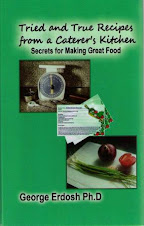
Tried and True Recipes from a Caterer's Kitchen (Nov/08)
The Efficient Cook
You are a good cook if you can retrieve a recipe quickly, produce a good, healthy meal efficiently while enjoying the process, yet you are running a green kitchen. TRIED AND TRUE RECIPES aims to help you with exactly that - to make you a more efficient cook by knowing what you are doing, not simply following recipes. A little bit of science, lots of useful tables and charts; they all help your cooking efficiency.
Tried and True Recipes
Book Description
Tried and True Recipes from a Caterer’s Kitchen—Secrets for Making Great Foods
by George Erdosh
ISBN978-1-60693-198-1. Suggested retail price $26.50. Hard cover, 239 p. Eloquent Books, NY
Kitchen and cooking are love/hate subjects. Those who love the process look at and collect anything and everything that has to do with cooking and food. This book, Tried and True Recipes from a Caterer’s Kitchen, was written for the kitchen and food gurus, yet it is also an ideal book for those whose kitchen’s purpose is to make coffee and heat frozen meals in the microwave, but who want a better daily fare.
The book includes a wealth of information useful in everyday cooking for beginners and serious cooks: references, charts, sidebars and tables that can help with cooking, baking and shopping--tools that very few cookbooks include. Undoubtedly, such information makes anyone a more efficient, quicker and a better cook.
Using my background (Ph.D. and working career in science), I peppered the text with tidbits of physics and chemistry related to cooking to give the cook an understanding of what is happening inside the pot while it is over the fire.
The 42 recipes in the book are truly tried and true; most of them came from my catering kitchen. I have used them repeatedly, improving and perfecting them over the years until they are foolproof. All recipe ingredients can be found in any well-stocked market and, with a few exceptions, require no special culinary expertise to prepare. Although they came from a catering collection, the recipes are down-scaled to family size for everyday use.
This book is useful in any cook’s kitchen library.
George Erdosh
The author is aculinary scientist, food writer and certified cooking teacher with a strong science and research background (Ph.D., McGill University, Montreal).
He is the author of eight published food-related books: a six-book series for young readers Cooking throughout American History and The African-American Kitchen (all seven by The Rosen Publishing Group) and Start and Run a Catering Business (Self-Counsel Press),numerous articles, including in magazines such as Bride’s, Odyssey, Better Nutrition, Home Cooking, The Fisherman and Bowhunter; and newspaper food sections, including Chicago Tribune, Christian Science Monitor, San Francisco Chronicle.
The author emphasizes basic cooking knowledge by explaining the hows and whys of food and cooking through kitchen-level physics and chemistry that enables readers to be better and more efficient cooks.
A Reader’s Review
This is an excellent choice for all levels of cooks. Each chapter gives a few pages of information about cooking science and "how to do it." The recipes are interesting and come from various cuisines. Dr. Erdosh is very knowledgeable and writes in a pleasant folksy way, informative but not pedantic.
Excerpt from Chapter: Kitchen Tools to Keep—Kitchen Tools to Trash
Copyrighted: DO NOT REPRODUCE
Absolutely Essential Kitchen Tools
There are only two essential kitchen tools, a set of excellent knives and a large, sturdy cutting board. Knives vary tremendously in quality and price. It is best to ask around and preferably heft a knife in your hand before deciding
on this critical tool. Low-priced knives waste money in the long run. Find something in the medium- to high-priced range, and you will pass them down to your heirs for use in the next generation.
If you already own a set of knives that you don’t like, replace them. Four knives are essential in every kitchen: a large eight- or nine-inch (20 or 23-cm) chef’s knife (measured from shaft to tip of blade) with a curving cutting edge that you can rock tip to shaft on a cutting board, a small paring knife, a thin-bladed carving knife (or electric knife) and a large serrated bread knife. Cutting boards come in different sizes, but equip yourself with the largest, sturdiest you can find. A second, smaller cutting board for little jobs like slicing cheese or cutting up an apple is useful to have around as well.
Cutting boards may be thick hardwood or heavy man-made polyethylene– they are both equally good and safe.
Nice-to-Have Cooking Tools
Spice grinder or mortar and pestle
Nutmeg grater
Pastry brush, vegetable brush
Lemon reamer (taps juice without cutting up the lemon)
Lemon zester
Pastry cutter (cuts fat into dry flour mix)
Strainers (one coarse, one fine)
Ski or swimming goggles for chopping onion
Plastic bowl scraper (quickly cleans bowls)
Ice cream scoop
Two to four portion scoops (like ice cream scoops), 0.5 to 3 oz (15 to 90 ml)
Melon baller
Garlic press
Potato masher
Salad spinner
Kitchen scale
Quiche pan
Spatter shields (keeps frying food from spattering)
Although originally a mineral exploration geologist (35 years), I drifted into high-end catering (10 years) and (concurrently) into frelance food writing.
I have numerous stories mostly in newspapers' food columns and nine published books (see blog).